IVR vs AI Voice Agent: Key Differences, Use Cases & How to Choose in 2026

18 mins read

Posted on May 22, 2026

Saravana Kumar
SEO


Saravana Kumar
SEO






“I was charged twice this month. Can you help?”
A customer calls support at 8 PM on a Friday, only to hear, “Press 1 for sales. Press 2 for support. Press 3 for billing.” The customer has a question, but the system wants a button press.
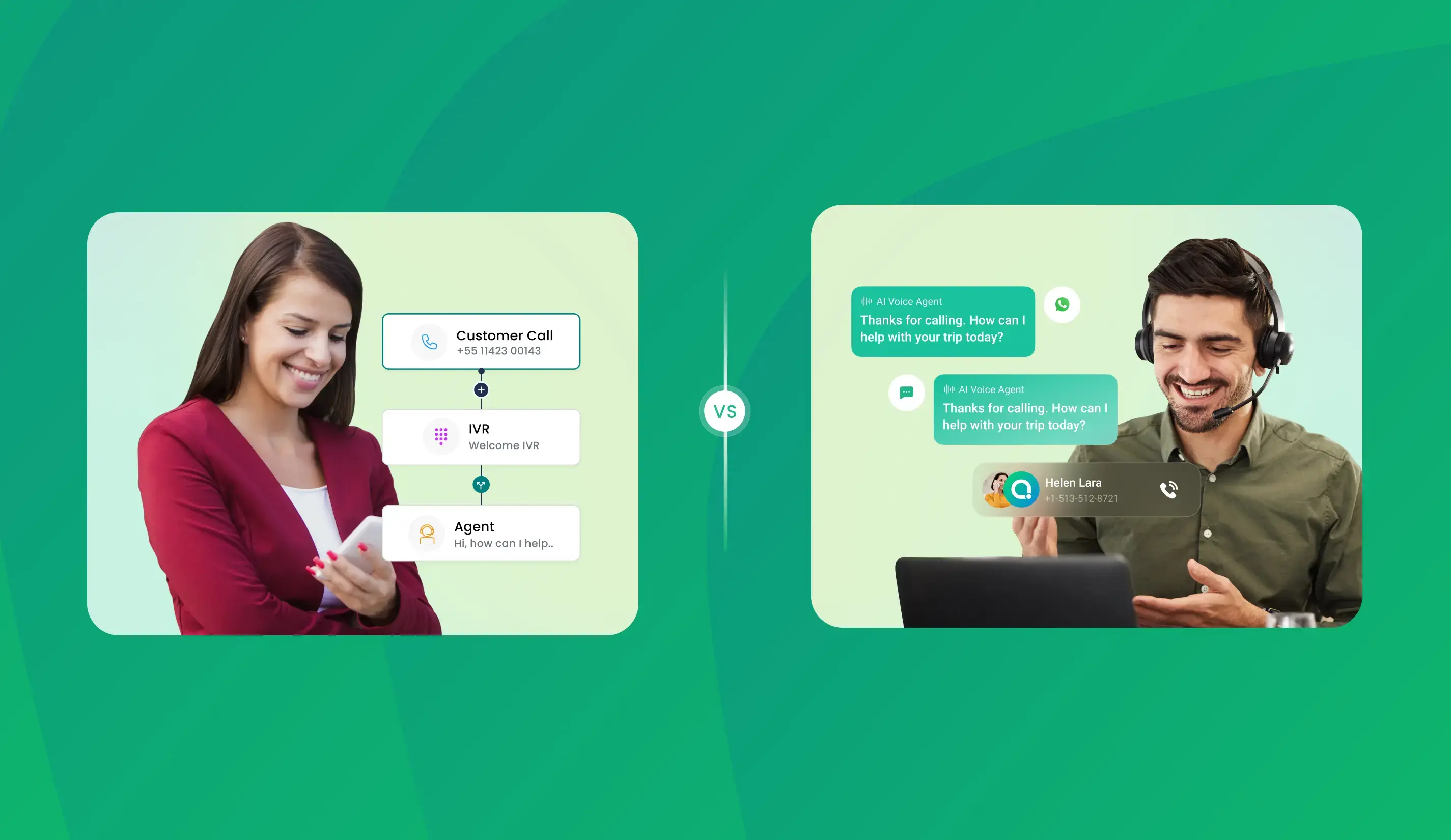
Traditional IVR sticks to a fixed menu. An AI voice agent can actually understand what the caller wants, ask clarifying questions, and solve the issue if your systems are connected. The difference goes beyond how customers interact with a phone system; it changes what the system can do.
So, when it comes to the IVR vs AI voice agent decision, which approach fits your business? Let’s compare their capabilities, explore where each works best, and look at ten questions to help you decide.

Key Takeaways
 IVR works best for straightforward calls - It helps callers reach the right department or get basic information through menu options.
- AI voice agents handle back-and-forth conversations - Callers can explain what they need, answer follow-up questions, and get help with supported tasks.
- Choose based on your needs - Call complexity, integrations, language support, compliance, and cost all play a part.
- You can use both together - IVR can manage routing while an AI voice agent handles conversations and passes calls to a human when needed.
- Start with the calls you want to improve - Look at what's slowing your team down before deciding whether to keep IVR, add an AI voice agent, or change the call flow.
What Is IVR?
Interactive Voice Response (IVR) is an automated system that directs incoming phone calls. It lets callers select options using their keypad or voice to get basic details or reach the correct team, saving your staff from manually transferring every single call.
Where IVR works well:
- Reaching the right department - Help callers connect with sales, support, or billing without having to speak to a receptionist.
- Answering common questions - Provide details such as opening hours, services, and account information.
- Managing a large number of calls - Apply predefined routing rules across incoming calls.
- Handling calls outside business hours - Play announcements and guide callers when staff aren't available.
Where it falls short: IVR struggles with anything outside its main menu. Callers with complex or unusual requests often end up going in circles before asking for an agent. More modern systems can do a bit more, but their flexibility is strictly limited by your configuration and software integrations.
For a closer look at how it works, read TeleCMI’s IVR guide.
What Is an AI Voice Agent?
An AI voice agent is software that handles phone conversations using speech recognition, natural language processing, and, in many systems, large language models (LLMs). Instead of asking callers to choose from fixed menu options, it interprets their intent and responds to what they say.
What AI voice agents can do in 2026:
- Understand natural speech - Callers can explain what they need instead of choosing from a fixed menu.
- Keep a conversation going - Ask follow-up questions and use earlier answers to understand the request.
- Handle interruptions - Respond when callers interrupt or change their minds, depending on the system.
- Work with business systems - Access CRM details, check availability, or complete tasks through authorised integrations.
- Speak multiple languages - Handle conversations in supported languages, though accuracy varies by language.
- Transfer calls to human agents - Pass callers to the right team when they need further help, along with relevant conversation details.
Let’s say a customer needs to move an appointment. They can talk through their availability with the agent just like they would with a person. As long as the agent has access to your calendar system, it can look up open times and change the booking automatically.
AI voice agents are also called AI voice bots, Intelligent Virtual Assistants (IVAs), or conversational AI agents. Vendors may use these terms differently, so focus on what the system can actually understand and do. Its performance depends on the underlying technology, integrations, configuration, and calling conditions.
IVR vs AI Voice Agent: Full Comparison Table
Here is the full feature list comparison for IVA vs IVR.
HubSpot's customer service statistics report that 75% of customer service representatives surveyed said they saw the highest-ever volume of customer service tickets in 2024. This finding provides context for the pressure service teams face when managing demand
Where IVR Still Wins in 2026
You do not always need an AI to handle your phone lines. If most of your incoming calls follow the exact same pattern, a IVR system is still the easiest option. Here are 5 situations where a standard menu works just fine:
1. Simple, predictable call flows
If a business knows where a call needs to go or what message the caller needs to hear, IVR is usually sufficient. It can route calls to sales, billing, or technical support & play standard messages, such as business hours or payment confirmations. There's no need for AI when a fixed set of options can do the job.
2. Compliance-sensitive workflows
In sensitive industries like healthcare, insurance, or finance every call path needs to be tightly controlled and easily audited. Traditional IVR fits these strict requirements naturally. While you can use AI voice agents in these environments, they require additional compliance controls and monitoring.
3. Budget-constrained teams
When a business simply needs to direct callers and answer basic questions, standard IVR is a far cheaper place to start. Before picking a platform, make sure to look at all underlying expenses. This may include user licenses, custom integrations, ongoing maintenance, and actual usage rates.
4. High volumes of basic queries
If callers are constantly asking for office hours, store locations, or department numbers, simple recorded messages get the job done efficiently. High call volume by itself isn't a reason to buy AI - it is the complexity of those calls that actually matters.
5. After-hours routing
Standard IVR handles the afterhours calls just fine by announcing closing times, taking voicemails, or offering the emergency contacts. But if callers need actual problems solved or personalized help while your office is closed, an AI voice agent is worth the investment.
Where AI Voice Agents Win in 2026
AI voice agents are useful when callers need more than a menu to choose from. They can understand what the caller wants, ask follow-up questions, and handle tasks they are set up to manage, provided they are connected to the right systems.
1. Complex, multi-turn conversations
Billing disputes, loan enquiries, and appointment changes often take more than one question to sort out. An AI voice agent can keep track of what the caller has said and ask follow-up questions to understand the issue, instead of making them go through several menu options. Tasks such as checking balances or changing bookings depend on having the right integrations and permissions.
2. High-volume repetitive support
Many customer calls are about routine tasks, like checking an order status, asking about a refund, or booking an appointment. Since these requests tend to follow similar steps, AI voice agents can handle them in large volumes. Human agents focus on more complex issues.
3. 24/7 issue resolution
IVR can manage calls after hours by routing callers or taking callback requests. AI voice agents can go a step further by checking information, answering common questions, and completing tasks they are set up to handle. They also need the right system access and an escalation path for issues that require human support.
4. Multilingual customer bases
A business serving customers across India may need to handle calls in Tamil, Telugu, Kannada, Hindi, and more. AI voice agents can speak supported languages and handle some conversations where customers switch between them. Before putting one into use, check how well it understands different accents and callers speaking in noisy surroundings.
5. Reducing friction and call abandonment
Callers can explain their problem directly instead of working through menus that may not always fit their needs. This can cut down on the frustration and transfers. Call completion rates, repeat calls, and customer feedback can show where it needs improvement.
If you're considering whether to replace IVR with an AI voice agent, start with a focused pilot on a high-volume, well-defined use case before changing your entire phone system.
Explore how AI voice automation and IVR can work together inside a single platform
Talk with an ExpertThe Hybrid Model: Using IVR and AI Voice Agents Together
IVR and AI voice agents can work together rather than being used separately. IVR can direct calls to the right team, while AI voice agents can handle conversations and routine requests.
How the hybrid model works
An AI voice agent answers the call, understands what the caller needs, and tries to resolve the request. If the caller needs specialist help, the call can be transferred to the right department or queue along with the details collected so far.
There is no single sequence that every business has to follow. Some use IVR to direct the call before the AI voice agent takes over. Others start with the AI voice agent and use routing rules for transfers or escalation. It depends on the business's calling process.
Why businesses may combine them
IVR keeps call routing organised, while AI voice agents can understand the callers who explain their needs in different ways. Using both lets businesses manage queues and transfers while automating calls that don't need a human agent.
Businesses can also introduce AI voice agents one step at a time. They can start with a common type of call, check how well it works, and expand to other requests once the results are consistent.
A practical example: Loan application enquiries
Suppose a customer calls to check on a loan application. An AI voice agent can ask for the details it needs and check the application status if it has access to the relevant system. If the customer has a more complicated question, it can transfer the call to a specialist using the configured routing rules.
Where the system supports it, the specialist also receives the information collected by the AI voice agent. The customer can then continue the conversation without having to repeat the same details.
Where TeleCMI fits into this architecture
TeleCMI provides cloud telephony infrastructure, call-routing capabilities, IVR, and APIs that businesses can use to connect phone calls with external AI applications. An AI voice agent may be supplied or developed separately, while TeleCMI provides the communication layer required to connect it to the calling workflow.
Before going live, make sure the necessary APIs and integrations are in place, calls can be transferred correctly, and the AI voice agent has the right data access and escalation rules. Not every AI feature or integration comes built in with a telephony connection.
How to Decide: 10 Questions to Ask Before Choosing
The decision between IVR and AI voice assistants is not merely a technological one. This is about the experience your customers will have, the system's cost efficiency, its response time, and the scalability of your support team. Instead of trying to figure out which technology works better, the right question is which type of technology will best suit the way your company communicates with customers.
Here are 10 practical questions that can help you decide.
1. How Complex Are Your Customer Conversations?
If your callers usually need to take simple steps, such as choosing a department, checking their account balances, or paying their bills, then IVR systems are often the right solution. But when customers explain their issues in different ways or need further clarification, AI voice assistants will be a better fit.
Best fit:
- Simple and straightforward communication → IVR
- Dynamic and complicated communication → AI voice agent
2. What Is Your Daily Call Volume?
Companies with less call volume might not require sophisticated conversational automation technology. As call volume escalates, repetitive calls are causing delays and increasing hold time. An AI voice agent will address these issues while keeping costs from skyrocketing.
Best fit:
- Low to moderate call volume → IVR
- High-volume support operations → AI voice agent
3. Important Is Reducing Hold Time?
Customers get frustrated with long wait times, which increases their likelihood of abandoning the conversation. While an IVR system can alleviate such pressures through routing, an AI voice agent handles customer inquiries without human intervention.
Best fit:
- Basic routing needs → IVR
- Faster resolutions and lower abandonment → AI voice agent
4. Do Your Customers Speak Multiple Languages?
IVR systems can support multiple languages, but only in a limited way, using strict menu options. AI-powered voice bots offer greater flexibility for handling different languages, as customers don't need to use layered menus to place their orders.
Best fit:
- Limited language requirements → IVR
- Diverse or multilingual customer base → AI voice agent
5. Are Most Calls Repetitive?
Your customer service might be repetitive, with your agents handling routine billing, scheduling, order updates, and similar queries. In such cases, you can rely on an AI voice agent, which would automate all such tasks.
Best fit:
- Mostly routing-based support → IVR
- Repetitive support automation → AI voice agent
6. What Is Your Budget?
IVR solutions tend to cost less to deploy and manage than AI voice agents. AI voice agents entail a higher initial cost but may lower future costs due to their ability to handle repetitive tasks.
Best fit:
- Tight infrastructure budget → IVR
- Long-term efficiency investment → AI voice agent
How Important Is Customer Experience?
Customers expect that support systems be fast and conversational in nature. Although traditional IVR menu systems have been helpful in guiding customers to where they need to go, there is usually frustration in going through various routing options.
Best fit:
Functional call routing → IVR
Experience-focused support → AI voice agent
8. Do You Need 24/7 Customer Support?
IVR systems can route calls outside business hours, but they usually cannot handle detailed customer conversations. AI voice agents can answer questions, collect information, schedule appointments, and assist customers even when human teams are offline.
Best fit:
- Basic after-hours routing → IVR
- Full-time automated assistance → AI voice agent
9. Are You Operating in a Compliance-Heavy Industry?
Industries such as banking, insurance, and health care sometimes demand scripted workflows and proper documentation. The role of IVR technology is still useful since it guarantees consistent and controlled calls. AI voice agents will be ideal in these scenarios too, but most probably alongside structured workflows.
Best fit:
- Strict scripted workflows → IVR
- Flexible support with structured controls → Hybrid setup
10. Are You Planning for Scale Over the Next Few Years?
Some firms need a simple system to route calls at present. Meanwhile, other companies are expecting growth in the coming years and will be scaling up their customer support operations. AI voice agents can prove to be a good choice for such cases.
Best fit:
- Stable support operations → IVR
- Growth-focused automation strategy → AI voice agent
How should you interpret your answers? If most calls follow a set pattern and need clear routing, IVR may be a good starting point. If callers need to explain their issues and complete tasks over a conversation, consider an AI voice agent. If you need both, a hybrid setup may work better. Make the final decision based on your call data, risks, integration needs, and overall cost, rather than just counting which technology came out on top.
The Future: What Happens to IVR as AI Adoption Grows?
The development of conversational AI does not make traditional IVR redundant. Instead, businesses can choose which parts of their call flows benefit from natural-language interaction and which are better left as structured processes.
Conversational automation can make certain calls easier by letting people explain what they need instead of navigating multiple menu options. The system can ask follow up questions and retrieve information from connected systems. Behind the scenes, businesses still need to manage call routing, authentication, escalation to human agents, and call records.
A gradual rollout can be a practical way to get started. Businesses can choose one use case, measure how well it works, and keep their existing routing in place wherever it still does the job. They can then add conversational automation to other areas based on the results.
For that reason, a gradual approach can make sense. Businesses can begin with a specific, measurable use case, retain their existing routing where it works, and introduce conversational automation where testing shows a clear advantage. Over time, they can expand, adjust, or remove components based on results.
Not every business needs to move away from IVR. What matters is having a call flow that handles routine calls efficiently and gives customers a clear way to get help with more complicated requests.
Wrapping Up
IVR works well when the calls follow a predictable pattern, while AI voice agents are better suited for requests that need a conversation and access to connected systems. The choice depends on how the customers call, what they need, and what the business can support in terms of cost, integrations & risk. Businesses that need both structured routing and conversational support can combine the two.
Frequently asked questions (FAQ)
Saravana Kumar

I’m passionate about exploring and sharing insights on modern cloud communication technologies. At TeleCMI, I focus on helping readers understand the evolving world of cloud telephony and IVR solutions in a simple yet in-depth way. My goal is to deliver genuine value by turning complex telecom concepts into clear, actionable knowledge that builds trust and drives innovation.